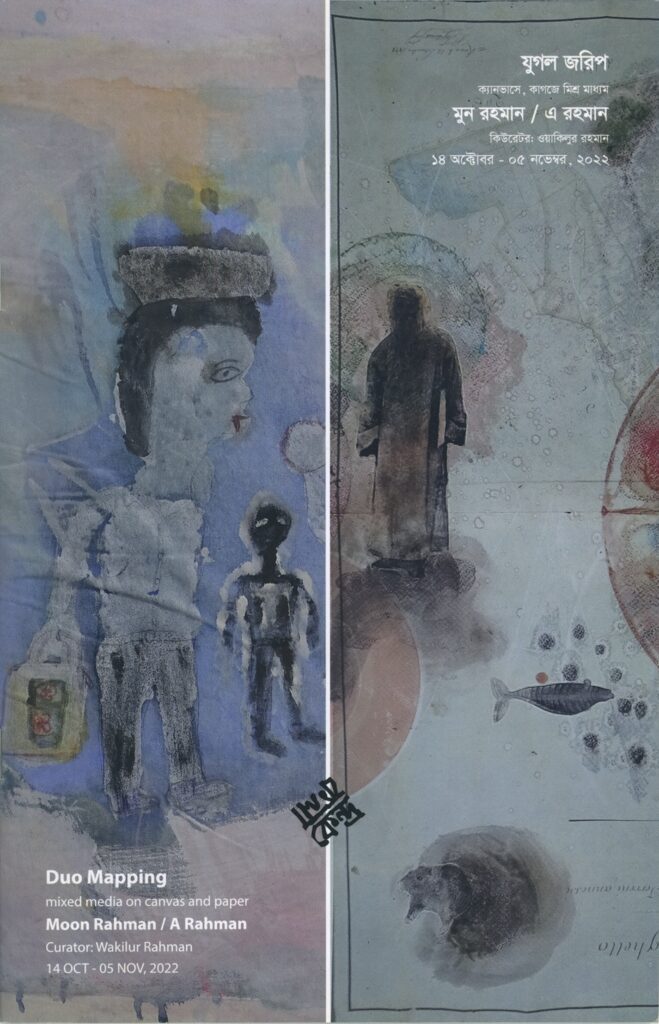
Duo Mapping challenges one with the task of navigating the works by two artists who are heteronormative partners in life; who, in spite of sharing the ecosystem of a singular exhibition space, also firmly stand apart in their own visual representations, arguably, of a journey in time, if one may.
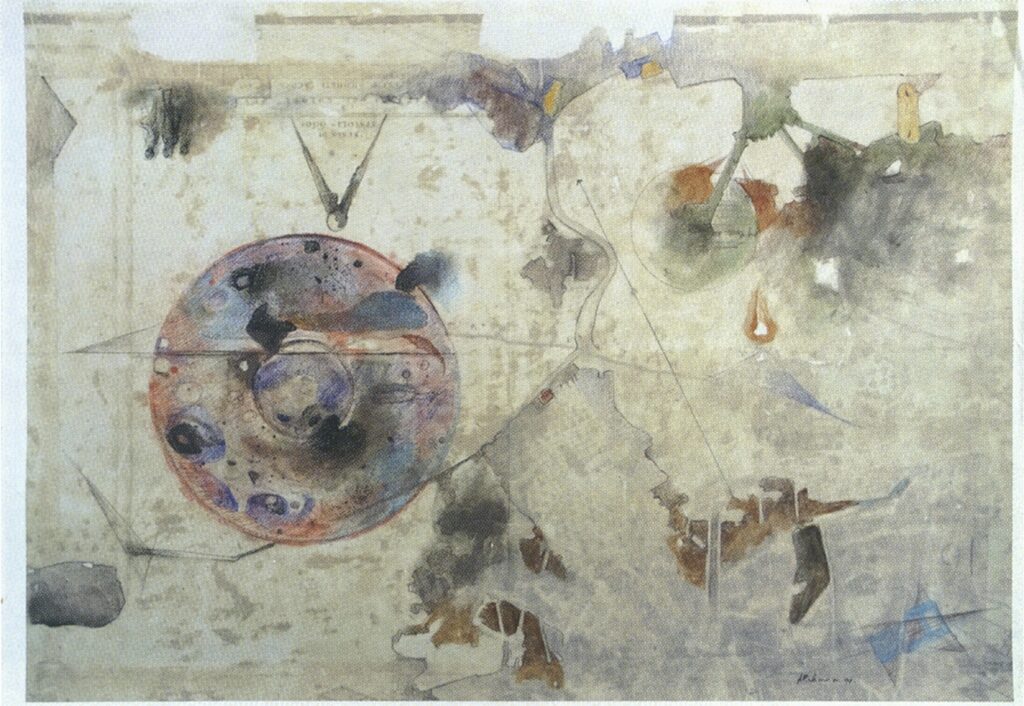
The circularity and rotatory motion of time is invoked in the disc like forms that appear with a leitmotif regularity across A Rahman’s body of works, although in the manner of a counterintuitive reiteration of time encapsulated in a known historiography. He inscribes a flattened globe on the surface of old maps he retrieved from the city of Napoli. Tracing what is supposedly ‘real’ (the actual map), he etches an idealist imaginary where historical time and space is compressed, and all divisive boundaries dismantled. What emerges is a levelled plateau freed of geo-political markers and subversively placed on the spatial/temporal identifiers and designated co-ordinates of a map. This re-mapping is redolent of a crucial desire to situate a displaced mind-body in the temporality of an unknown locale.
Rahman charted a (mental) route carrying him from Feni to Dhaka and finally to Rome. He created this series of works shortly after his arrival in Rome, which hence is representative of a re-imagining of his personal negotiation. of a passage across borders, which culminated in a resolution as he erects a menagerie of’worlds’that otherwise remains apart. He rearranged his new domicile with signifying elements from a known semiotics– that of a historical narrative. He coalesces time that has already been organized so as to project it onto a ‘future’ which to a migrant is his lifeline.
Cuing on perhaps this thought and in conjunction with the exhibit items, one finds lines drawn on the floors in the likeness of a system of graphic signage em placed in the human commons to control human mobility, and to demarcate zones of access and its denial; at the same time regulating the rhythm of time.
The curator of this show, Wakilur Rahman, in an attempt to counteract ‘white-cubism’ has taken down vital architectural elements of a building to transform the space in a way for it to resemble a public thoroughfare. The floor is converted to look like alleyways leading through turns, corners, openings and hidden pockets. Considering this spatial rearrangement, again-is it yet another act of vested cartography to salvage a ‘future’? With reference to this exhibition-there seems to be a lack of disarray (though functional) which is characteristic of the ‘everyday; which is deeply rooted in the idea of thoroughfares.
Borders in their spectral manifest are reservoirs of a spectacular narrative of disorientation and its associative pathologies. As a result of the active imagination of cultural creatives all across the world co-opting the trope of crossing-overs, more persistently in the last decade or so, and spawning out an entire capital of semantic production, the art world being no exception-schooled eyes are quite famil iar with the traces of these narratives. Saying that, however, one could never downplay the perpetually and increasingly laden stories of hope and despair playing out along the trails of crossings, the tales of putting behind only to reach out for what remains elusive and the looming threats of recurring psycho-(ethico/politico)-somatic fall outs which might both be generative and detrimental at the same time.
In A Rahman’s muted, almost sepia world, migration is made visible ‘cloaked’ in an element of wonder. Again, it is worthy of mention in the service of contrapuntal reading, that dislocation goes hand in hand with an economy of exploration which in essence is more of a psychical,
existential exploit and a survival necessity. It is in th is spirit A Rahman ‘memorializes’ an imaginary of ‘passing through; a temporal manifesto unveiling his very personal journey through spaces re-cognized and re-constructed; qualified with an occasional spectre of a spillage into what is yet to be perceived. Nonetheless, what meets the eyes is a mental graph scored across a virtual map of an imaginary space. It is akin to an archival palimpsest of’time; erected to bring certainties to bear on the uncertainties of a future to be tamed.
The seekers may find a moody evocation of cave paintings in the subtle jaggedness of the textures, or associate the earthiness of the musty palette with that of old, time-stained maps. However, A Rahman’s world is decisively flat. His printing press ironed out the creases of a potential phantom historicity of global market-driven paradigm to make room for the short journey between the domain of the bison which got replaced by the domesticated cattle; following the by-now-familiar-pattern cave men also are seen evolving into modern, organized civil forces of resistance/change. But these wheels of change trundled along the historically marked ruts of’modern civilization’. We see how the Global South or shall we say ‘East meets West’ and so do their apportioned , discrete ideologies. Then, tribute is paid to an assembly of venerable figures from across history, not to mention to ‘the spirit of muktijudhdho’ via the decoupage which sits squarely on maps from Napoli. A Rahman plays the savant with a flair for anachronism. The emphasis on the flatness becomes apparent as one observes the centrifugal formation of visual objects across the plane. These are interspersed with imprints of disks, or objects representing the technology of recording/archiving repurposed and repeatedly used. The techne of calculated bricolage and repetitive use of motifs point to a conceptual precursor that seems to preside over every piece of work.
Crossovers are also bywords for intertextuality which is implicated in the ‘Duo’ of the title. It is not so much the binary between this and that, as it is the overlapping between seemingly opposites which forms the brewing grounds for new dialogues/debates and hence, which is
ground rife enough to reel out multiple strands of co-existing iterations. The juxtaposition or let’s say co-mingling of Rahman and Moon brings one thing in stark relief though, which is the stark contrast between their approaches to the works on view. One might even be tempted to pass a verdict along the line of how Rahman’s directness and prefabrication is visibly counterpoised by Moon’s livid yet subliminal forays.
However, it is quite -apparent that the virtues or propensities that remain nascent on A Rahman’s staging grounds are made flesh in the ungrounded unfolding of Moon’s disruptive eruption of images rendered via a violently colourful spectrum. Moon Rahman’s works, offer a recipe for turning an image inside out. Here, the exterior is rendered diminished (although not ruled out all together) in the twisting swirl of a vortex that pulls the gaze inside, even though the lightness of her strokes and the opacity of colour along with the deliciously rudimentary drawings, all work together to make the figures float on the surface. Eliding formal verisimilitude, Moon’s figures are reminiscent of a childlike fantasy and a playfulness that has a touch of the macabre. Hers seems to be a gestalt of the ‘mirror stage; where the gaze ruminates the image of the self in its relationships with the immediate environment. A Rahman’s ‘world view’ transmutes into Moon’s query into the very nature of her relationship with various matrices of an ‘order’ she inhabits. Gazing eyes are ever so prominent in her canvases. Then there are blotches, splashes, spillages-in other words, each frame is a testimony to a certain reckless abandon with which Moon accosts her canvas. Each ‘scene; might transpire as one of domesticity, yet it hits hard with the force of multi-expressive, gestural and a refractive immediacy which seems to reflect an embodied experience of a ‘passing into’.
From another angle, her body of works is characteristic of a play on contrasts. Not only do the contrasting colours create sensorial moods that vary from frame to frame but the contrast between childlike innocence –a blooming girl with a body of a butterfly, children at play amidst their animal counterparts sharing a space undefined, un-categorized-and the grotesquery of a face spilling out worms is absolutely startling!
Her canvases speak through ‘self-referentiality; that which dispels and displaces all arrivals/entryways to a ‘this is it; by transposing it with ‘there’s more to it’– which lends urgency and inimitable nuances to her works. The circular flow visible on her canvas could, if one may, be indicative of a (un)realization of a cyclical future distinct from the myths of a linear past; the former-a natural habitat of a human mind (or memory), and the latter is what human mind is prone to creating and re-creating in search of a mooring.