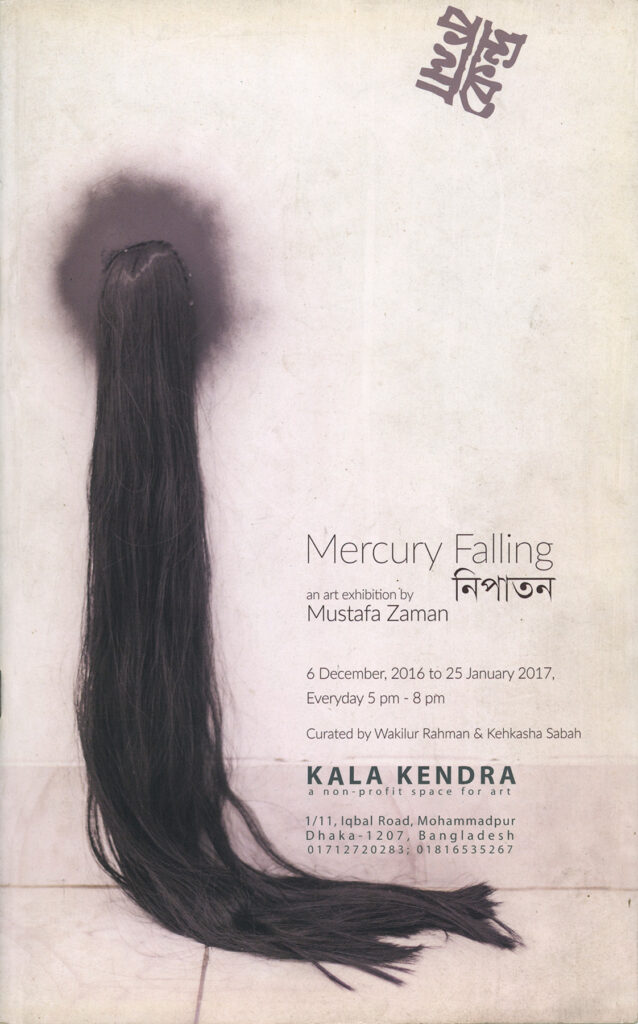
A series of photographs that breaks the languor of longitudinal display is what greets one as one enters the space, unsuspecting, where the pared-down exhibit, Mercury Falling has been put on view by Kalakendra. The non-linear mounting guides the gaze to travel from eye-level to the foot of the wall or the ground to rise again up to the ceiling to follow the descent of a piece of thread, barely visible, to come to rest on a pair of eyes staring back from under a mound of wicks from burnt incense sticks. The gaze continues to follow the trail of works unhindered as a sparse spatial relation has been created between art objects -in keeping with the physical reality of the rooms that house them. The exhibit seems like an attempt not so much at the denial of reality as its gradual erasure, an ephemeralization of what we take for granted, especially if photographs be the reproduction of the known then artist Mustafa Zaman. looked beyond the apparent, beyond the mere perceptual to devise a voyeurism that lusts after the unknown, for that which defies the gaze, however might it be recompensed by a spectral premonition of what lies beneath/outside. Objects disappear from the recognizable semiotic field to reappear as a de-signifying lens placed over a defamiliarized ‘event’, a manufactured photograph. that hews almost to an artifice. using a disfiguring technology wherein pages from magazines have been photographed using a mirror that resulted in a merger between ‘pictures’ and their reflections to produce grotesque figures, humans transfigured into phantasms. invoking the primal fear of ‘deformation’. of anonymity/de-personification, as faces dissolve. limbs spawn and multiply into unidentifiable forms. As gazes reciprocate, as an exchange takes place between object or its image and the viewer, or when one stands in front of a mirror. the spectator’s experience of viewing is altered from that of intimidation as one risks being objectified to one of conciliatory participation in making a visionary space, where senses are unleashed through a process of de-objectification. Alterity slips into a f1ux, I/eye as well as the spectacle becomes fluidly interchangeable. Mercury Falling allows no room for a curtain call.
The plasticity of space, pliability of objects is played upon to create an atmospheric ‘absence’ where contexts are made to lose their contours to run over into a continuum of being one with the other. Collaged photographs drawn over and re-photographed with hints of watercolour washes point to technologized multiplication of images that progressively recede from the actual, the mundane, albeit having been drawn from it. A caveat of violence flows placidly beneath the images of cross-sectioned bodies. A mallet hangs against a white wall. next to a suggestively bleeding finger, an exposed body becomes its own ‘virtual’ parody, its displacement further compounded by the placement of a prosthetic limb with a hoof in front of what could be a fluid re-configuration of a genital.
The walls are turned into a (tele)portal opening onto parallel possibilities metaphorizing the collapse of all grand-narratives. of all spatio-temporal boundaries/historicities, as we see a lock of hair cascading down the wall, the back of a miniature horse caught in motion as if while passing through the wall. Zaman’s acute sensitivity to spatial articulation is evident in the thoughtfully wrought visual texts/ drawings on the walls as it appears that a dialogic collaboration has taken place with the traces of previous art events. Objects and shapes come into view to inscribe themselves onto the palimpsest of art-staging.
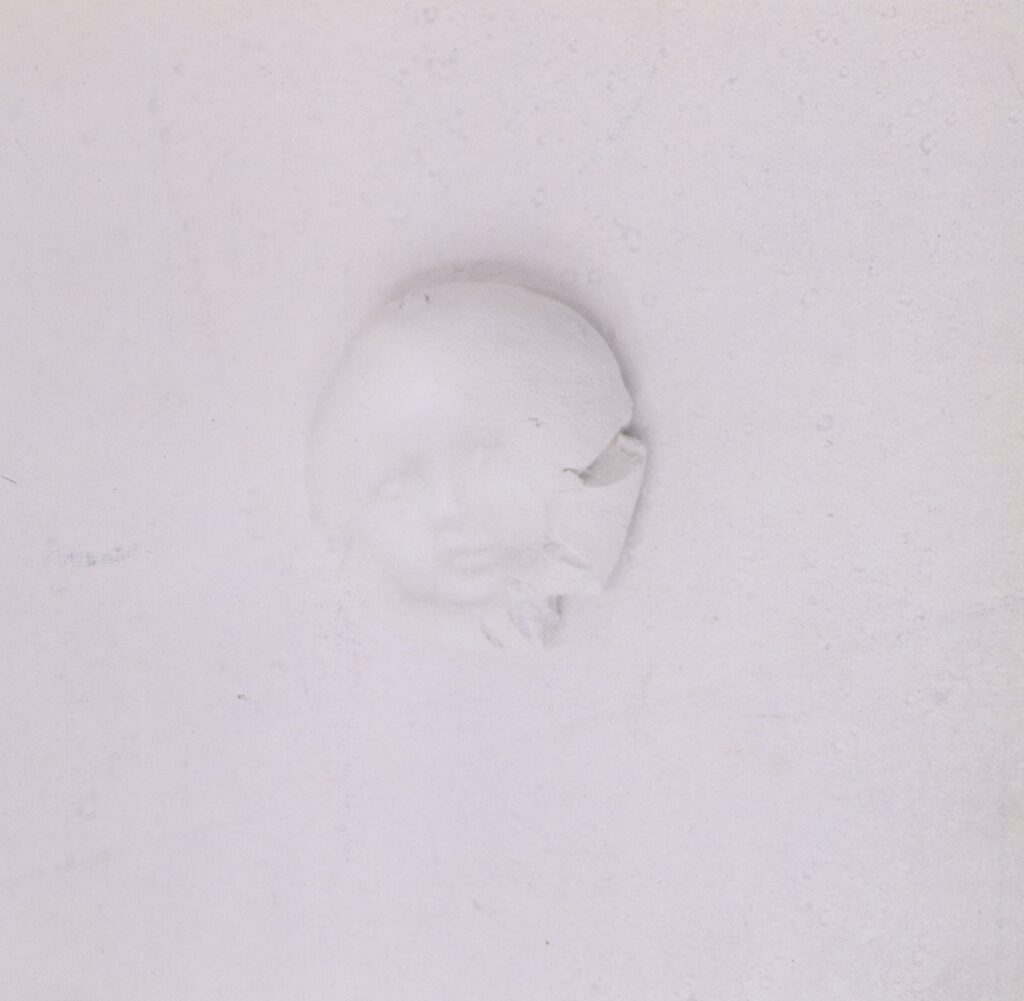
A mirror is mounted at the far end of a dividing wall, more like a waft of an after-thought blowing in from the headwind of nostalgia, bringing to mind of something seen before, of ‘myself’, a fissure wrought in the narrative of non/un-being with this verification of presence by both recognition and association. When objects of vision fade away what remains is a reflected/ing gaze that stares squarely back at the gazer. As is seen in a cluster of doctored photographs of a man’s back turned to the spectator ending in a ref1ector. It is all in all a meditative space, where objects/images appear and recede as the mind receives (or does not) the sensory impressions at will. An aura of evanescence if not transcendence halos the installations. The paradox of rituals in the form of ephemera rooted in a faith system; the sacred space — that venerated imaginary that looms and presides over the banalities of object-centric life -becomes a dominant theme. The niche that nestles idols in a temple faces a crushed cage that hangs suspended nesting a clump of hair, perhaps as a symbol of a cycle of loss and renewal. The emptiness of the niche becomes a reservoir of memories imbued with desires and aspirations arising from lived practices which though worldly are steeped in libidinal-metaphysical ambition. lnsubstantiation is a recurrent tendency that transmutates objects. gently delivering them into the realm of self-reflexivity as instanced by the glass sleepers. The geometric patterns drawn on the floor sprinkled with powder, with round moulds bearing impressions of faces placed across the pattern in replication of an ancient ritualistic diagram together with the white-sprayed bonsai seem to feed on our imagination of ‘the thing beyond.’ Layering turns into a stratagem to render the visible suspect as photographs are overlaid with objects; hence releasing them into the web of co-dependent interpretations. Mercury Falling is a reminiscence of memories of loss, but not a lament With a celebratory afflatus Zaman tries to point our mental gaze to the ‘odhora’. the essence of something larger, greater, the stuff of which our dreams and as such we are made of.