A. Preamble
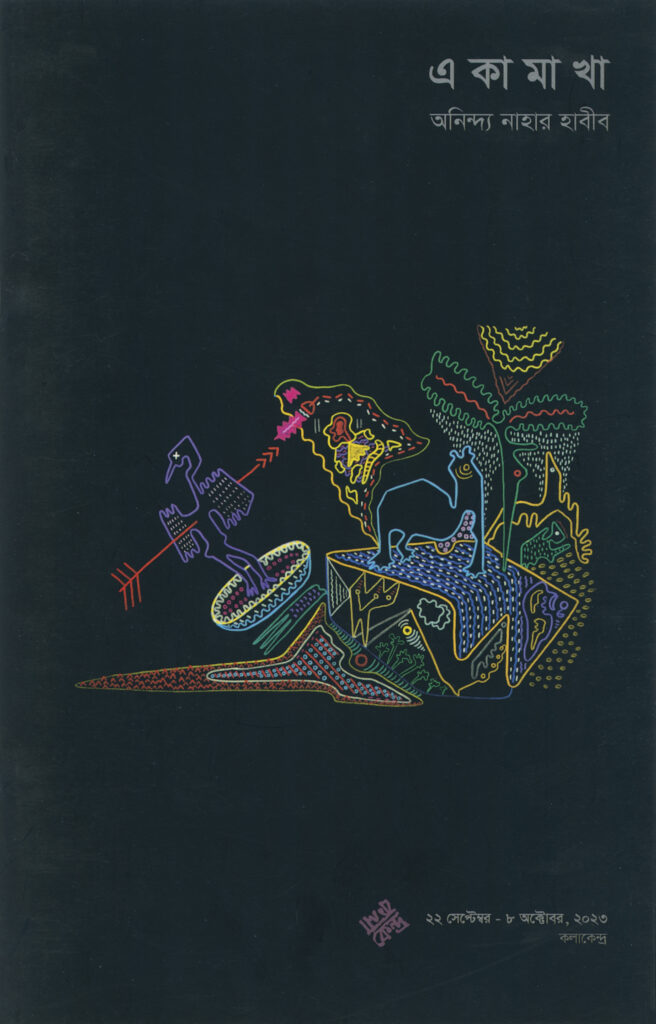
Anindya Nahar Habib, amply exhibits his penchant for lines, colours and complex patterns (sans sporadic exceptions) and a marked tendency toward clutter, chaos and excess in his works. Visually pleasing, conceptually suave, his works seem to draw on the techniques of archaic art forms– a case in point, too obvious to miss! However, upon closer inspection, one becomes aware of a rogue sensibility at play. After the gaze gets used to the quixotic sprawl, and one is compelled to pore deeper, what emerges from the apparently flat surfaces– reminiscent of a ‘screen’ in the age of ‘augmentation’-is a slow reeling out of a meandering thread. Following its trail, one is enabled to piece together a layered narrative that is both intriguing and intoxicating.
Now, if the proverbial critic steps in –upon scrutiny, one might detect the symptoms of a searching self inhabiting these works, existing as both a ‘me’ observed from a distance by an observing ‘I’. Transformed into a discursive painterly approach, this interplay offers itself as a key to unlocking and demystifying the body of works compiled under “Eka Makha”. Referential and deferential in a charmingly witty, select, visual representation of ah ahistorical evolution of human-world connections, “Eka Makha” unravels as an inquiry into the mystery of life.
Regarding the interplay of ‘me’ and ‘I’ (the first taken in the sense of being acted upon and the latter as an ·acting agent), one might argue, while the strain ‘me’ is busy dabbling in and consequently combining known traditions of image-making as a way to wishfully coming into its own, the strain ‘I’– the discontent overseer, channels its pseudo agency into consistently pushing the boundaries in search of novel expressions! And caught between this tug and pull, the will to outgrow/to overcome seems at times to succumb to containment.
“Eka Makha” captures a state of simultaneously being at one with and apart from others. Consequently, the self that searches multiplies in its plight or pursuit across multiple directions; rejecting the notion of a singular destination; albeit, at risk of losing its way.
B. Reflections
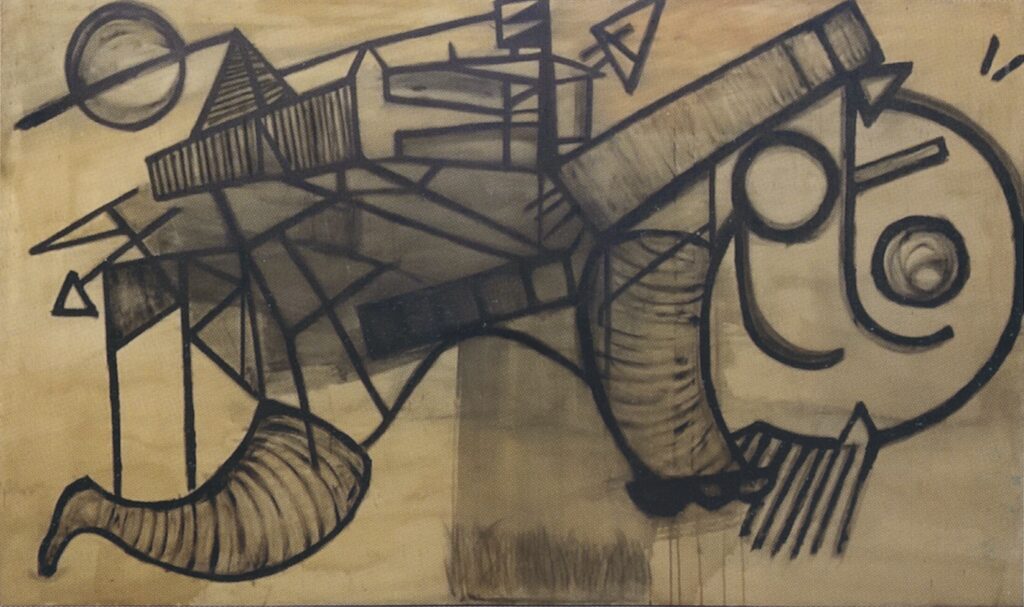
Anindya is a loner in a crowd; sometimes spontaneously doodling away while hanging out with friends, at other times, he is burning midnight oil working on several canvases over an extended period. Anindya ‘timeshares’ these simultaneously developing works based on a common scheme of colour, or so explained the artist. This durational ‘mode switching’ coupled with a conscious play of colours breathes life and whimsy into the linearity of his work, which. often presents itself sprinkled with a bit of irony. In most of Anindya’s works, colours are applied more in keeping with the innate dynamism/vitality, disregarding their encoded representationality. Black canvases and white papers are overlaid with colours (often fluorescent), applied to achieve clever effects of interest, harmony, emphasis, illusion of depth, and most importantly contrast–with the austerity of forms juxtaposed against their fantastical flamboyance.
In Anindya’s works, mythology of the past shares the same space as the quintessential urban condition of the present. Anindya’s ‘time’ is ahistorical, manifesting as fragmented snippets of events visually curated within balanced and streamlined compositional field. In other words, Anindya’s artworks resonate with the essence of the immediate, which is brought to bear afresh with every stroke executed on the pictorial planes.
The artist places his faith not only in the plasticity of his lines, the gesturality of his ‘broader strokes’ but also in their intrinsic impetus to bring obscure (suggestive yet dis/figured) forms/shapes into view. Yet, his manoeuvres often come across as stilted, engineered and moreover, as a relentless push toward an irreconcilable resolution. His land/mindscapes come perilously close to crystallization, in spite of a whispered promise of shape-shifting recklessness. Anindya Nahar Habib is a devotee to his emotions, embarking on a linear unleashing of his mentalscape across the planes of canvas/paper. His approach to work is influenced by a slow burn of both empathy and detachment which is felt at the time of viewing, as one becomes aware of a mind which though intimately invested in the making of the work remains largely skeptical of the end. Lines, forms and colours gradually accumulate through a gesturally choreographed stream of consciousness. Ultimately, what emerges are visually charged signs of an elusive representational act that, despite all efforts to break free from the apriori, furtively returns to it. Mimicking the paradox of human existence suspended between the empirical and the unknown, his pictograms (if one may) come tantalizingly close to going berserk, yet remain tamed. Their contents reshuffled, consciously or unconsciously, to fit within the paradigms of semiotics. A close look affirms how a potentially shifty form is intentionally made to resemble a giraffe or how, following the lead of lines, an elephant materializes during deliberate contemplation or a discernible ‘tree/cycle’ of life appears as one ponders the larger scheme, much like shapes emerging from drifting clouds or patterns arising amidst the chaos of existence.
C.Addendum
Here is an emerging artist– an adage which is used with apologia and without assertion– who admittedly creates his own recipe for art practice by assembling traces and semblances of previous but extant artistic expressions. ls this not what might fall uneasily under the category of the PoMo pastiche? Here is Frederic Jameson, putting a foot in the door; to him, “Modernist styles … become postmodernist codes … a field of stylistic and discursive heterogeneity without a norm”. One might lament the lack in such works, of the zeal of the authentic, or that of its minion– idiomatic representation; but what comes with this syncretism is the liberating ‘modern’ license to give expressions to the unfiltered, “limbic” emotions/feelings/and all such un-nameable experiences human existence thrives in. If an artist is a visionary, then the whole project of plunging into the layers of the psyche/consciousness (too mind boggling!)– laden with their own components of belonging to help understand our multiple existences– is bound to feel heavy. That too by an individual who is also an inheritor of criss-crossing, far-reaching legacies of the relativity of triumph and failure of previous artistic endeavours! So, one is simply
wont to find his own voice which might be music to his own ears even when inhabiting a tower of Babel (turned an echo chamber). Anandya Nahar Habib, as he observes himself in his world/s , performs his ritualistic practices ( of life and art) and ‘does’ venture into creating experiential terrains/plateaus of co-existence (with a view to entities/phenomena both sentient and otherwise), is caught tracing visibly the invisible intra-actions/connections between ‘beings’ and ‘things’ of his very own “eco-system”. And as all of these arrive at the exhibition space panned out in a spectacular display-it surely startles and dazzles …
Yet, one has a feeling that a lot is left to be desired, moving forward!
Anindya glides seamlessly across a wide ranging ‘cultural capital; drawing on ancient myths/theosophy, primitive art forms, local traditions, as well as epoch-defining global literature. By defamiliarizing through the integration of their diverse fictional nuances within the domains of contemporaneity, Anindya Nahar Habib creates his fabulist metafictions. His works serve as testament to the inescapable artifice inherent in human experience. However, one may ponder, do these fictions belie the ‘real’ or does it, in effect, bring us closer to it?
By assigning seemingly unrelated captions/titles to some of his works, Anindya conveys the shape-shifting, be-all/fits-all open-endedness of his works, opening doors to endless interpretations –from subtle social commentaries to nods at the political climate and hints at the blurred divide between fiction and reality.
In conclusion, one might take a bold step forward in assuming that Anindya is working his way through mapping out utopian plateaus where forms continuously emerge and dissipate undulating in a chain of relational/differential connections, as he steadily edges toward new, yet immanent possibilities. One can only wish that he continues to advance his explorations/forays with every tool available, as time is undoubtedly on his side!